
A Brief History of Midsomer Norton Rugby Football Club
Genesis (R. Tovey)
"Mr Edgar Heal, Chairman of Paulton Hospital asked me to arrange a rugby match in aid of the hospital. A match was arranged on Welton Rovers ground in April 1936 verses Cotham Park XV, as I had previously captained the Park second XV. The stand was full and over £10 was collected for the hospital.
Subsequently a meeting was called at the Greyhound Hotel. Mr Edgar Heal being in the chair. It was unanimously agreed to form a club. The officials being, President Mr W. Harvey, Chairman Mr E.C. Heal, Captain B.A. Edwards, Vice-Captain R.N. Tovey, Match Secretary H.S. Shearn, Hon. Treasurer, A.T. Rawlings. The first ground was Mr Garrett Taylor’s corner field, Withies Lane, with changing quarters and Headquarters at the Greyhound Hotel, and the colours being Cherry and White hoops.
The first match was 5th September 1936 vs Wells Cathedral School at Wells, arranged by Ray Taylor, a scholar there. He later played for Norton at the beginning of the war and again in 1946. Norton played with 14 men – a farmer Kremer crying off at 12.45pm and it was impossible at that time to get a substitute; however, we won by 5-3, thanks to a conversion of Peter Toye’s. Included in the team was Lance Dymock, who had not played rugby before, but he soon adjusted and himself and later became a very successful Hon. Sec. and made a life member. Lewis ‘Tim’ Shearn was converted from Welton Rovers and preferred rugby, as did Gordan Talbot.
Norton Fixtures were mostly 2nd XV’s from the Bath and Bristol Combinations. We won the next four matches, but played a strong Combe Down 1st XV including ‘Shamer’ Weeks, Bath and Somerset forward, who converted all their tries (7). We lost 0-35. However, in 1939 when the war started, we beat them 10-8. We were augmented by soldiers of Devon Regiment, including E. Friend (Devon and Torquay), also Pimblett, who later played Rugby League for England. After a successful first season in 1937, we saw a full fixture list, also a new ground near Coomers Grave.
A thrilling local Derby at Keynsham ended in a 6-6 draw on Boxing Day. Hugh Watts, Somerset cricketer and war time Blue then at Downside scored the tries. Mention must be made of Bill Ellis, a master at Downside, who led the pack. A notable fixture against HMS Osprey from Portland (a naval training ship) who brought a big crowd of sailor supporters resulted in a 11-3 win and a fine performance from Norton. The following season at Portland we played the United Services and arrived with only 13 players, we were augmented with 2 Borstal boys from the nearby detention centre. We were beaten 33-0, not surprisingly as they had two representative naval players and 3 Hampshire players. We were all entertained in their Mess.

Another new fixture was Bart Hospital on their ground at Chislehurst. This match was arranged by Bill Taylor, a member of Midsomer Norton, a medical student there, as was Colin Edwards. However, the medical team won 11-8 and later we visited the Criterion Theatre. The following year we played them again in appalling conditions, rain throughout, this we won 6-3, Gerald Jenkins, a Grammar School boy, scored a try. After the war he got a Rugby Blue, also played for Bath and Somerset. The other try was scored by Roy Candy, a soccer player, who came in at the last minute. He dribbled through the markers and then three yards from the try line, stopped and said “What do I do next?”, so we all yelled “Put it over the line and touch down!”. 1938/39 saw another new ground, North Road, also a new captain EN Tovey and Vice-Captain EHL Shore. We were strengthened by more rugby players moving into the district, notably George Howarth from Hartlepool. The first match of the season was at Frome. In the first minute Norton were awarded a penalty, Harry Shearn who was a very successful place kicker said it was too far for him, it was just inside our half, George spoke up and said “I’ll take it”, he did, and with a tremendous kick it sailed over the bar. The touch judge didn’t even bother to go over. We won 29-3. George Hogarth didn’t stay with us long as he was soon spotted by Bristol, and played with them before and after the war, and for Somerset. Another local derby was with Shepton Mallet, on the showground, resulting in a hard match 0-0. Norton with 13, Hogarth cut his forehead, Ernie Shore dislocated his collar bone. I understand the nurse on duty at the hospital said “Shepton playing at home again?”. Ron Smith made his debut at the tender age of 14. Easter saw the visit of Blackheath 1st XV, the match being arranged by George Haydon, a Nortonian, who played for us at Christmas and Easter. He was a Blackheath, Bath and Somerset player. Until recently he had the record for 19 tries. He captained Norton on this occasion and a very large crowd saw Norton beaten 3-16, but not disgraced. The following week Norton did well in Bath 7’s losing to Trowbridge (the winners) in the semi-final. The seven being, Colin Meadows, Harry Shearn, Brian Edwards, John Maloney, Prior Smith, Ron Jacey (Captain) and one other. The new Captain for 1939-40 was Colin Meadows, Vice Captain, Prior Smith. However, until the war commenced, most of the players being in the forces, rugby was continued on a monthly basis. Norton then augmented by soldiers from the Devon Regiment stationed in Norton, also members coming on leave were given a game."

Second World War
Our Members who made the supreme sacrifice: Lt. Ken Cobb, killed in Burma P/O Don Harvey, R.A.F. Guardsman Jack Perry Mike Cahill, Merchant Navy Sgt. Dave Cranston, R.A.F.
1940s and 1950s (Geoff Cox)

“After the war the Club resumed with a mixture of pre-war members and new young players, mainly from the Grammar School and other players who had been in the services and married local girls. For the next 15 years the membership was mainly ex-Grammar School pupils.
Two teachers in those days influenced the school players, one was “Wicker” Readhead who had also played for the Club pre-war and Doug Evans, during the fifties and sixties. During this period the Club had only one team and with only a few members owning cars, had to travel to away matches by coach. There was many an occasion where the team was found to be short at the last moment and it was then necessary to drive to various other players homes to encourage them to turn out at the last moment. It was also essential to allow additional time for two things, one Robbie Bailey’s need to make numerous stops for relief and Geoff Cox’s directions on short cuts, inevitably finishing up in a cul-de-sac. Rackvernal Road became well known for its association with the Rugby Club. The Club played on the old pit field six years after the war, before being forced to move to Norton Down in the field adjacent to its present headquarters. The force which made the move necessary was the encroachment of the slag heap, as the colliery was still being worked at the time. The touch line nearest the ‘batch’ became a quagmire in places and the wings were forced to make long leaps, as well as running. Sludge seeped between the grass in one in-goal area and it became quite common for visiting try scores who dived over to be covered completely in grey sludge.

The original Norton Down pitch had only one amenity and this was a hollow tree next to the pitch, which was quite a convenience. When the soccer finished on the council playing field in Rackvernal Road, the Club gained permission to use it and to erect its first changing quarters. What a change to be able to wash under showers from the original method of washing used over the years. This entailed the use of three galvanised baths and a Primus stove to heat the water. Thirty-one persons bathed in these.
From 1947 to 1950 an old scout hut was used adjacent to the ground and then Bob Purnell, who was then Club President, allowed us to use the cloakroom at Bob’s Palace, the local night spot then. When particularly muddy conditions prevailed, it was not uncommon to see players washing off the majority of the mud in the High Street river outside. When Stan and Monica Wilshire were at the Greyhound, which was the club’s headquarters, they allowed the Club the use of an old stable as changing quarters and also the use of the skittle alley and the club room for our own bar and dining room. Alan and Bertha Simmons were the next tenants and because of their considerable help in many ways, it took much deliberation and agonising decision to take the plunge and move to the old British Legion headquarters and become completely independent. Thankfully that decision marked the turning point in the Club’s history and it has progressed gradually in playing and financial strength since. It was mentioned earlier about our varying accommodation and this was also the same for other clubs, it varied from small huts, farm buildings and out-buildings attached to pubs, to the luxury of tiled accommodation in cub houses like B.A.C and Service camps. Our record is still held by the front row of the 50’s that is weighed 51 stone with Charlie Willmott and Geoff Cox as 18 stone props, and John Mounty as hooker. Mobility was doubtful but there were a lot of pushover tries.” (There have been much heavier front-rows since but this was a serious unit for the 1950s!)

1960s and 1970s (Maurice Carter)
"As the club approached the end of the 60’s, it was becoming apparent to the Committee that its playing facilities at Rackvernal Road were doomed, as the local council would only let the ground on an annual tenancy with rumours already existing of a proposed future development. Being a forward-looking Committee, enquiries were made in the area for land that would be suitable for a playing field and the present field was made available to the Club. The purchase took place with the financial assistance of the R.F.U and N.P.F.A. To bring the ground into operation, a large pond had to be filled in and this is under the present car park. During the filling in, under the supervision of Barry Dando, we managed to flood the main road when the land drain became blocked during a particularly wet spell. An old army hut was erected by a small army of members during a hot summer and the whole effort was nearly nullified when Chipper Jenkins decided to burn a load of rubbish and nearly set fire to the hut.

Concurrent with the ground development, the Club decided to go ahead with the suggestion of Pete Jenkins, to have its own clubhouse and bar, when he spotted the vacant premises in Northway on one of his visits to the betting shop next door. Wadworth agreed to help the Club, members renovated the premises, and the first pints of beer were sold for 10p per pint. John Presley proved an outstanding champion at Northway in devouring a pint and a yard of ale. A pint went down in 3 seconds and the yard in 10 seconds. A feat still unbeaten (at the time this was written). Chipper Jenkins also caused a few laughs with his eating habits, which included consuming daffodil bulbs and Ian Mountjoy ate tadpoles. On top of this Chipper managed to get himself locked in the skittle alley one night and only rang for help then, as there was no beer in that part of the Club. As the Northway Club was on a seven-year lease, the committee decided a more permanent club should be built at Norton Down and this was achieved during 1976. It was reliable reported that Charlie Lucas was the first inebriate member of the new Club, this taking place during pre-season trials. The playing performance of the 1st XV has risen to be one of the strongest in both the Bath and Bristol Combinations. The improvements commenced in 1975/76 when the team, captained by Nipper Pratt, won 35 out of 36 games played.”

1976 Season (A. Player from the Jubilee Handbook)
“We were on a high that day in 1976, a superb season, with only one defeat, a slipshod affair early in the season when the team played well below its capabilities. The team was buzzing, a record season nearly completed and a feint chance of – if we scored more than 75 points that day – an achievement of more than 1,000 points for the season. It seemed an unachievable target but nevertheless we will try. Poor North Petherton, little did they know what faced them on that day. It was an ideal day for running rugby, dry, warm and with a little wind most of which was supplied by our own scrum half. The whistle went for kick-off, the adrenalin flowed and battle commenced. It was like the viewing of an old movie, people were moving at twice normal speed. The team was unstoppable, half time passed and the points tally increased – 50 points, the magic 75 points and the unbelievable 100 points. Final result 108 points to 0. Nipper was hoisted shoulder high and carried from the field triumphant.”

1980s
Moving to Norton Down the Club consolidated its playing sides, running five regular Saturday teams with the occasional Vandals team. On Sunday a flourishing Junior Section operated, offering rugby to the 8 to 17 year olds with the addition of an Under 19's team.
The playing performance of the 1st XV had risen to be one of the strongest in both the Bath and Bristol Combinations. In 1980, captained by Bill Guild, they won the Somerset K.O. Cup becoming the first 'Junior Club' to win the County Cup thus qualifying for a first round game in the National John Player competition.
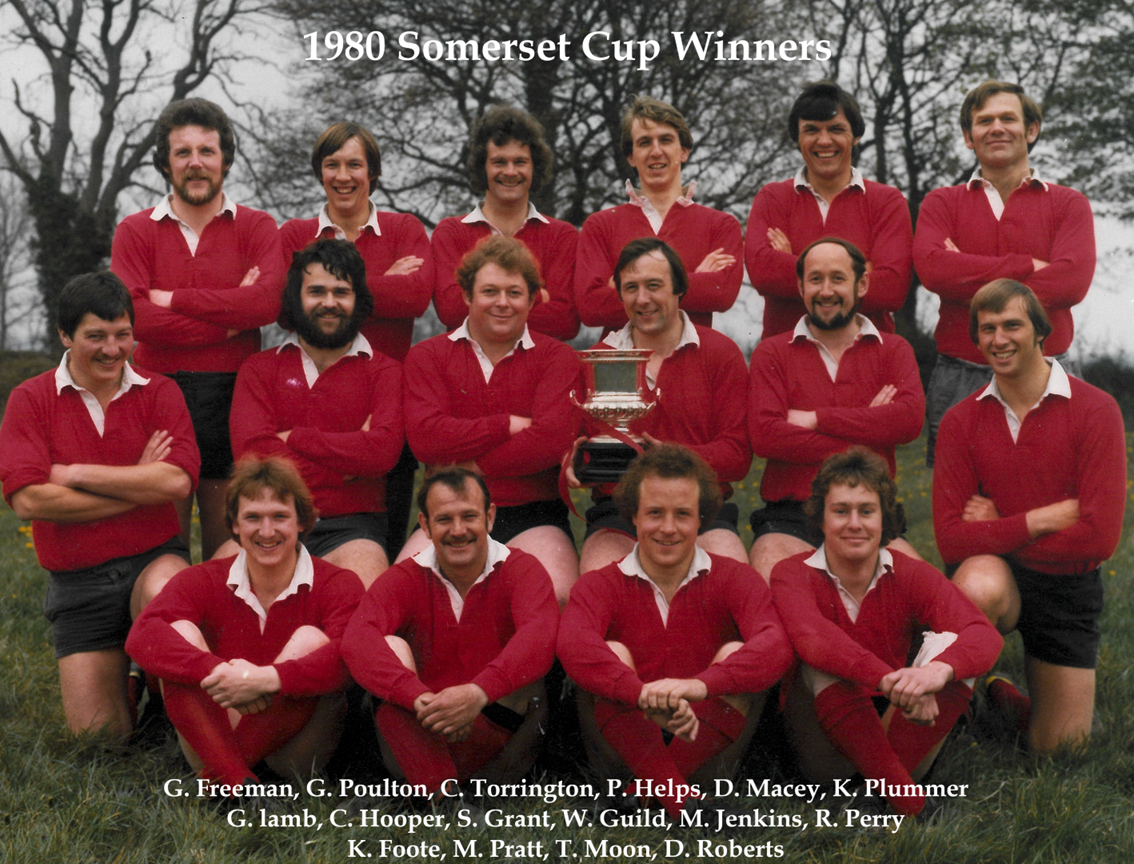
Memories of the 1980 and 1990 Finals (Terry Moon)

1980 – Midsomer Norton 9-3 Bridgwater (Weston Super-Mare)
“My memories of the first cup win centre around the sense of occasion beforehand in the changing rooms, the noisy Norton support and playing on the senior’s side of the pitch (Weston) and… the victory. We all knew we has the team to win yet were rated as underdogs as we were playing Bridgwater, a senior team. I believe our self-confidence was the ultimate key to victory.
The match itself apart from the result was a disappointing spectacle, marred by a very strong wind and a dominance of forward play. We had some exciting backs and great finishers on the wings in Duncan and Footey. The battle up front was huge, however our commitment, strength and determination never faltered with the front five of Grunty, Nipper, Danny, Ken and Mace dominating in the tight play and Avril, Donald and Lamby tackling relentlessly in the loose.
Bridgwater had the wind with them in the first half yet had only managed a penalty by the interval. We felt at half time that we could take this match, and so it proved. The match was levelled by a Graham Poulton penalty early in the second half and so it stayed 3-3 until near the end – extra time looked likely. Bridgwater became more desperate and conceded two late penalties, both of which I managed to convert (one from 45 yards) and the game was ours.
My treasured memory is playing against Mike Berry (Bridgwater scrum half) who shook my hand at the first scrum to wish me good luck and was the first to find me at the end of the game to say well done with the penalty, he later presented me with his new club tie – acts of genuine rugby sportsmanship and conduct.”

1990 – Midsomer Norton 10-6 Old Redcliffians (The Recreation Ground, Bath)
“The next time we won the Cup was 1990 when Steve Pratt was Captain. This was again a time where we recorded some great victories – Avon & Somerset Police on one occasion and a great semi-final win over Bridgwater to set up the 1990 Final with Old Reds. The Pack was in contrast to that of 1980 in that it was young. Fast and mobile, this time the backs were more mature with experienced players like Shon Roberts, Footy, and Rich Slater.
The final was to be played at the Rec, home of Bath Rugby Football Club. The Bath pitch was huge and the back three had their work cut out covering in defence and running hard in attack. As ever Dave Perret’s defence was solid and he constantly stifled Old Reds backs with trademark tackles. Norton were always on top with the mobility and guile of Dave Burge to the fore, ably assisted in the pack by Darren Ladd, Mike and Rob Ford.
The set-pieces went well with Steve reliably finding Jock in the lineouts and Danny Hooper, Digger and the captain dominating the scrums. The try came when I went off the back of a scrum, linked with Rich Slater who made a brilliant break and was clear. As the cover just managed to tackle him about 10 yards out, the ball was slipped to Shon who went over for the important try. It was not until 1992 that a try became 5 points, so this score and two penalties from myself against two penalties from old Reds gave us a 10-6 well deserved victory – a great achievement for the Club.”


